Tell us about the job
Takes about a minute. No obligation.
A heat pump in Forest County has not been running against a relentless weather load. 58 severe weather events were recorded in Forest County, Wisconsin between 2015 and 2024. At that rate, severe weather is an event in this county, not a standing condition, and a contractor diagnosing a failed compressor or a refrigerant fault here starts with how old the unit is, how it was installed, and whether it has been serviced. Those factors explain most of what goes wrong. The weather record gives a contractor useful context, but it does not carry the weight of the repair history.
A heat pump that has been cycling through Forest County winters long enough will show it inside the cabinet before it shows it on a thermostat reading. Half the homes in Forest County, Wisconsin were built in 1980 or earlier (2020-2024 ACS 5-year). That depth of vintage means a contractor opening a unit here is more likely to find a compressor contactor pitted from repeated starts, a reversing valve that seats imperfectly, or refrigerant fittings that have worked loose over years of thermal expansion than to find a single clean fault. Parts for systems that old are still available for some makes and discontinued for others, and that difference is what sets the repair scope before any labor estimate is written.
The Parts of a Heat Pump a Contractor Checks First
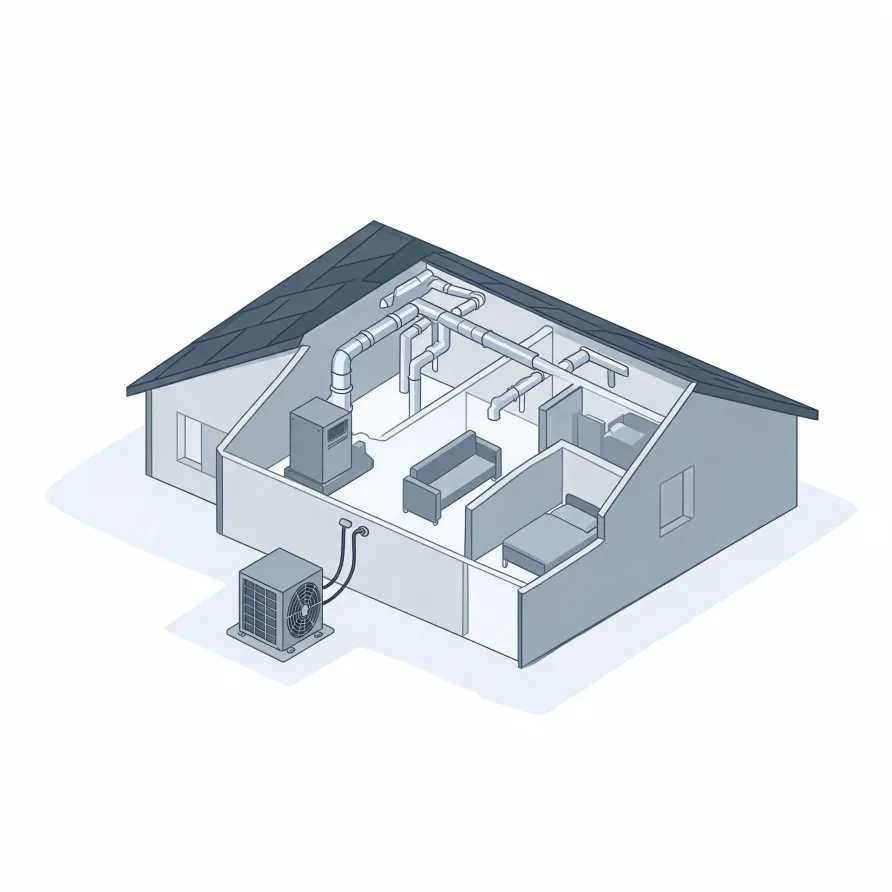
The outdoor unit sits outside the house and holds the compressor and the condenser coil. The compressor is where most repairs start: when it fails, the system stops moving heat entirely. The condenser coil wraps around it, and a refrigerant leak or physical damage there will show up as ice, warm air inside, or a unit that runs without doing anything useful.
Inside the house, the air handler holds the evaporator coil and the blower fan. The evaporator coil pulls heat from the indoor air, and a dirty or damaged coil is a common reason a system underperforms. The blower fan pushes conditioned air through the house, and a failing fan motor is something a contractor can hear and measure before it quits completely. Refrigerant lines connect the two units, and the reversing valve inside the system is what lets a heat pump shift between heating and cooling modes, making it a key part when the system works in one direction but not the other.
The drawing shows a typical layout, and a licensed contractor determines which components and conditions apply to your specific house.
Get matched in Forest CountyForest County, Wisconsin, by the numbers
58 severe weather events were recorded in Forest County, Wisconsin between 2015 and 2024.
NOAA National Centers for Environmental Information, Storm Events Database, bulk CSV export, events 2015-01-01 through 2024-12-31.Half the homes in Forest County, Wisconsin were built in 1980 or earlier (2020-2024 ACS 5-year).
U.S. Census Bureau, 2020-2024 American Community Survey 5-Year EstimatesForest County, Wisconsin holds 8,715 housing units (2020-2024 ACS 5-year).
U.S. Census Bureau, 2020-2024 American Community Survey 5-Year EstimatesOwners occupy 82.0% of the occupied homes in Forest County, Wisconsin (2020-2024 ACS 5-year).
U.S. Census Bureau, 2020-2024 American Community Survey 5-Year EstimatesCodes & Standards Covering Heat Pump Repair in Forest County, Wisconsin2 sourced rules and standards
Licensing and Legal Requirements in Forest County, Wisconsin
A Wisconsin business that employs a certified HVAC qualifier is a certified HVAC business, and no city or county may require it to hold a local certification or licence on top of that.
Wisconsin requires a state HVAC contractor registration: no person or business may install or service heating, ventilating or air conditioning equipment, or offer to, without one.
Severe Weather Events in Forest County, Year by Year
Heat pumps in Forest County work against whatever the climate throws at them, and that workload adds up. Stress from weather accelerates wear on components, and repair needs here reflect local conditions, not a national average.
58 severe weather events, 2015–2024. Source: NOAA National Centers for Environmental Information, Storm Events Database.