Tell us about the job
Takes about a minute. No obligation.
A contractor quoting heat pump repair in Burnett County has to settle one question before the work scope makes sense: which worn parts got there from the demands this area places on a running system, and which failed for reasons that would have shown up anywhere. 119 severe weather events were recorded in Burnett County, Wisconsin between 2015 and 2024. At that rate, compressor strain, refrigerant stress, and contactor wear are all reasonable starting points for a diagnosis, not because one storm caused a failure, but because sustained load accumulates in specific components over years of operation. A repair estimate that ignores that history will miss what actually needs replacing.
Ductwork and electrical panels in houses this old were built for whatever heating and cooling the house originally had, and the heat pump running in the house now was fitted into that existing shell at some later point. Half the homes in Burnett County, Wisconsin were built in 1983 or earlier (2020-2024 ACS 5-year). When a heat pump in stock this old needs repair, the question a contractor has to answer is whether the specific components that system takes are still in production. Refrigerant fittings, control boards, and reversing valves for units installed into older homes often sit in a parts landscape that has thinned considerably since the original install, and a contractor has to confirm availability before a repair scope means anything.
The Parts of a Heat Pump a Contractor Checks First
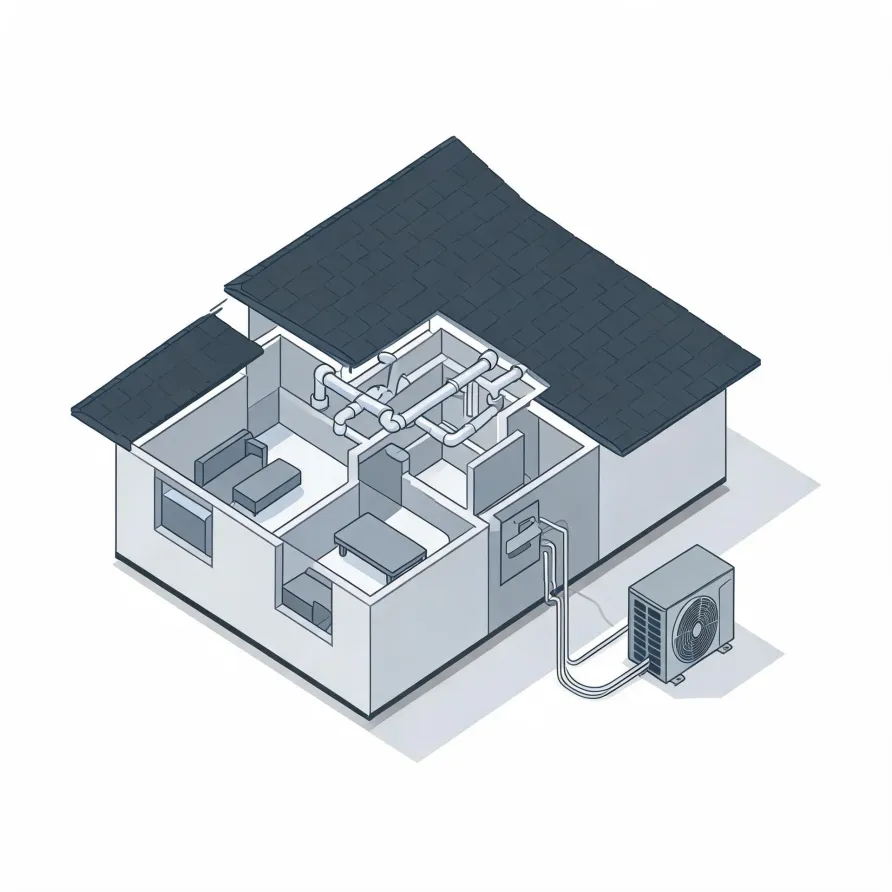
The outdoor unit sits on a pad beside the house and holds the compressor and the condenser coil, the two components a contractor reaches first when something goes wrong. A failing compressor often means the system runs but moves little heat. A damaged coil shows up as ice, refrigerant loss, or uneven temperatures through the house.
The air handler lives inside, usually in a utility closet, basement, or attic, and it pulls air across the evaporator coil before pushing conditioned air into the home. The reversing valve, which sits inside the outdoor unit, is what lets a heat pump heat in winter and cool in summer, and a stuck or failed valve is one of the first things a contractor tests when the system runs in the wrong mode.
The drawing shows a general layout of these components, and a licensed contractor determines what applies to the specific system and configuration in your home.
Get matched in Burnett CountyBurnett County, by the numbers
119 severe weather events were recorded in Burnett County, Wisconsin between 2015 and 2024.
NOAA National Centers for Environmental Information, Storm Events Database, bulk CSV export, events 2015-01-01 through 2024-12-31.Half the homes in Burnett County, Wisconsin were built in 1983 or earlier (2020-2024 ACS 5-year).
U.S. Census Bureau, 2020-2024 American Community Survey 5-Year EstimatesBurnett County, Wisconsin holds 15,396 housing units (2020-2024 ACS 5-year).
U.S. Census Bureau, 2020-2024 American Community Survey 5-Year EstimatesOwners occupy 85.9% of the occupied homes in Burnett County, Wisconsin (2020-2024 ACS 5-year).
U.S. Census Bureau, 2020-2024 American Community Survey 5-Year EstimatesCodes & Standards Behind Heat Pump Repair in Burnett County, Wisconsin2 sourced rules & standards
Licensing and Legal Requirements in Burnett County, Wisconsin
A Wisconsin business that employs a certified HVAC qualifier is a certified HVAC business, and no city or county may require it to hold a local certification or licence on top of that.
Wisconsin requires a state HVAC contractor registration: no person or business may install or service heating, ventilating or air conditioning equipment, or offer to, without one.
Severe Weather Events in Burnett County, Year by Year
Extreme weather puts real strain on heat pump systems, which run hardest when outdoor conditions are at their worst. How much wear a unit accumulates over time is a local question, shaped by what the weather in this area actually does.
119 severe weather events, 2015–2024. Source: NOAA National Centers for Environmental Information, Storm Events Database.